

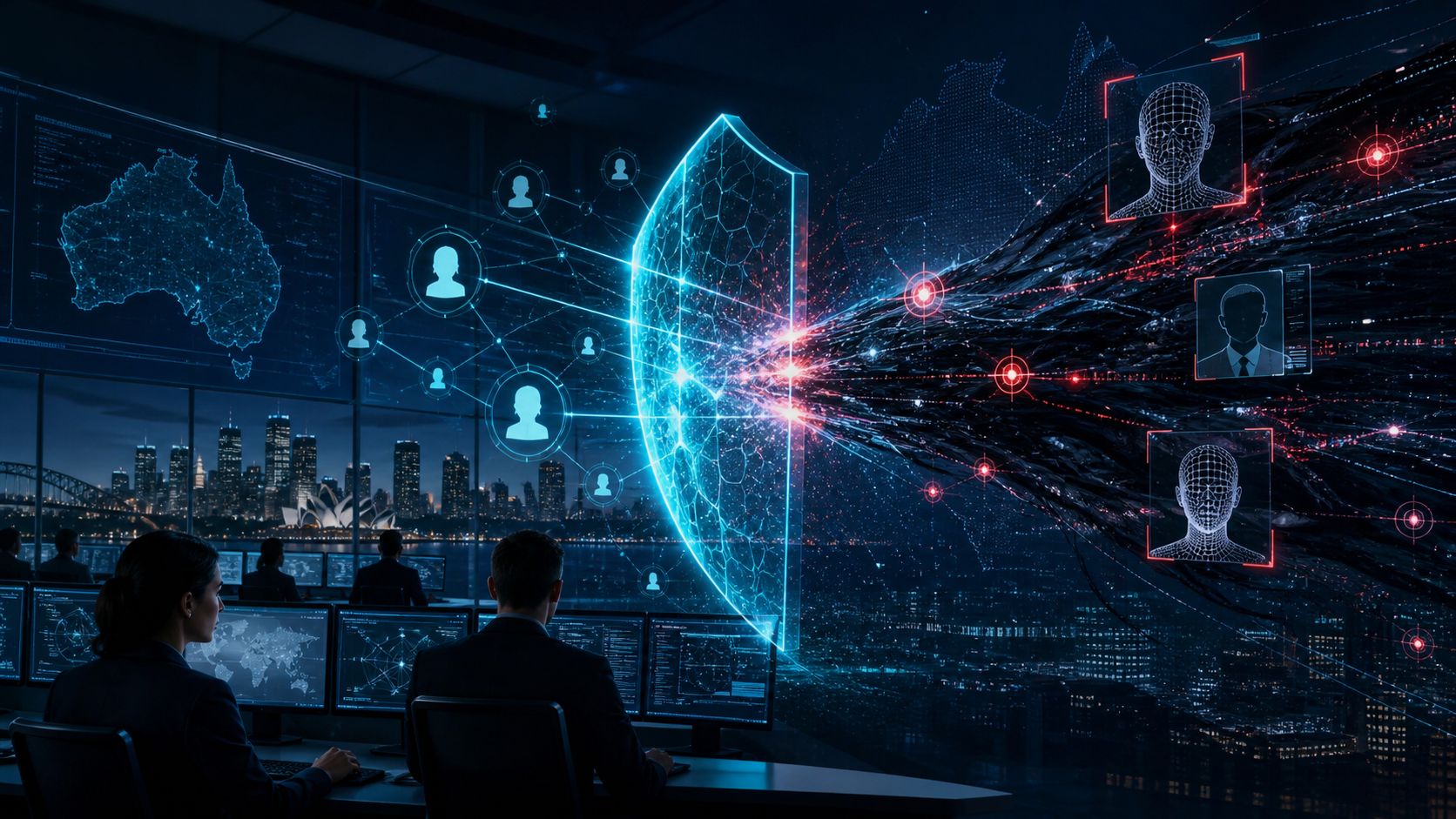
Most Australian organisations understand the basics of cyber risk. Phishing, malware, credential theft, ransomware. These are not new threats. What has changed is the machinery behind them. Artificial intelligence is enabling attackers to operate faster, target more precisely and adapt in ways that traditional security stacks were never designed to handle.
This is not a future problem. ASD responded to more than 1,200 cyber security incidents in FY2024-25, an 11% increase from the previous year, and received over 84,700 cybercrime reports, an average of one every six minutes. Attacks on critical infrastructure rose 111%. The average cost of a cybercrime report for Australian businesses increased by 50% to $80,850, with large businesses experiencing a 219% rise in losses. Globally, AI-generated phishing now accounts for more than 80% of observed social engineering campaigns, and deepfake-enabled voice phishing surged over 1,600% in early 2025. For Australian organisations still relying on disconnected tools and reactive processes, building effective AI cyber threat defense requires more than incremental upgrades. It requires a fundamentally different approach.
AI-driven attacks use artificial intelligence to improve how campaigns are planned, delivered and adapted. Rather than manually crafting phishing emails or probing networks one step at a time, attackers use AI to automate reconnaissance, sharpen targeting and accelerate execution.
The tactics themselves are often familiar. What has changed is the speed and precision with which they can be deployed, and how difficult they have become to detect using conventional controls. For businesses across Australia's cyber threat landscape, this shift demands detection and response capabilities that match the pace of the threat.
Phishing remains the most common initial access vector targeting Australian organisations. AI has removed the signals that people were trained to spot. Emails are now drafted in polished, context-aware language tailored to a specific industry, team or individual. The formatting is professional. The tone matches the sender. The urgency feels real.
ASD's 2024-25 report highlights information stealers and credential reuse as a critical and growing threat to Australian businesses. Attackers harvest credentials from one breach and use them to walk straight into other platforms. The Scattered Spider group demonstrated this at scale, combining social engineering with credential harvesting to compromise more than 165 organisations through the Snowflake campaign in 2024. No malware. No vulnerability exploitation. Just logging in as someone else.
AI-generated voice cloning has moved from proof-of-concept to operational attack tool. In 2025, the FBI warned of attackers using synthetic voice and text messages to impersonate senior officials. Deepfake-as-a-service platforms are now commercially available, making this capability accessible to threat actors at every level.
For Australian organisations where phone-based approvals, executive requests or supplier verification remain part of daily operations, this is a direct and immediate risk. The combination of AI-generated voice and publicly available information from LinkedIn, company websites and annual reports gives attackers everything they need to build a convincing impersonation.
Before an attack escalates, someone identifies where the weak points are. AI compresses that timeline dramatically. Attackers can scan for exposed assets, map identity systems, highlight likely vulnerabilities and prioritise the path of least resistance, all at machine speed.
CrowdStrike's 2026 Global Threat Report recorded the fastest observed eCrime breakout time at just 27 seconds. ASD's ACSC notified Australian entities more than 1,700 times of potentially malicious cyber activity in FY2024-25, an 83% increase from the prior year. When attackers move that quickly, incomplete visibility across endpoints, cloud, identities and networks is not a gap. It is an open door.
This is the shift that matters most, and Australian organisations have already felt it directly.
In March 2025, coordinated credential stuffing attacks hit five major Australian superannuation funds simultaneously: AustralianSuper, Rest Super, Hostplus, Australian Retirement Trust and Insignia Financial. Over 20,000 accounts were breached. Attackers used stolen credentials from previous unrelated breaches to log in to member accounts, and some members lost part of their retirement savings. Multiple funds did not mandate multi-factor authentication for login, leaving accounts protected by passwords alone.
No malware. No zero-day. No sophisticated exploit. Just stolen credentials and a login page.
APRA responded with mandatory directives requiring superannuation funds to evaluate and strengthen authentication controls. The incident demonstrated that identity compromise is no longer a theoretical risk for Australian businesses. It is the primary attack vector, and the consequences are measured in retirement savings, not just data records.
AI is enabling threat actors to accelerate malware development, produce polymorphic variants and cycle through evasion techniques faster than static defences can adapt. The Australian Government introduced a mandatory ransomware reporting regime in May 2025 for businesses with annual turnovers of $3 million or more and critical infrastructure entities, reflecting the scale and severity of the ransomware threat facing cyber security in Australia.
Environments that depend heavily on signature-based detection or controls that are rarely reviewed and tuned face increasing exposure.
The issue is rarely a lack of investment. It is architecture.
Most Australian businesses have accumulated firewalls, endpoint tools, email filters, cloud controls and policies over time. On paper, that looks comprehensive. In practice, those controls are often disconnected, inconsistently configured and dependent on manual intervention at every decision point.
AI-driven cyber attacks expose that fragmentation. If detection depends on a human noticing an alert, interpreting it correctly and escalating fast enough, the organisation is operating at human speed against machine-speed threats. That is not a fair contest.
The deeper problem is that most security stacks are still built around infrastructure telemetry: endpoint processes, network connections, file hashes. They answer what happened. They struggle with who did it and why. The superannuation attacks proved that point. When the attack begins with a valid credential and a convincing identity, infrastructure-centric detection has nothing to trigger on until damage is already underway.
Incident response is equally important. If an attack does get through, the business needs to know what happens next. Who investigates? Who isolates affected systems? How is the threat contained? How is recovery managed? A well-developed incident response capability helps reduce confusion when the stakes are highest.
The answer is not more tools. It is better integration, identity-aware detection and a response model that operates at the speed the threat environment now demands.
A capable Security Operations Centre provides the foundation. Continuous monitoring, AI-augmented triage and identity-correlated detection reduce the gap between compromise and containment. When an attacker achieves lateral movement in minutes, the difference between automated detection and a human checking a queue the next morning is the difference between containment and a breach.
If an attack gets through, the organisation needs clarity, not confusion. Who investigates. Who isolates affected systems. How is the threat contained. How is recovery managed. A well-developed incident response capability, tested and rehearsed before it is needed, reduces downtime, limits damage and protects operational continuity. With mandatory ransomware reporting now in effect for qualifying Australian organisations, the ability to respond quickly and document accurately is no longer optional.
As phishing and impersonation attacks become indistinguishable from legitimate communication, awareness training must evolve beyond outdated examples and compliance exercises. Staff need exposure to modern attack techniques including AI-generated phishing, deepfake voice calls and help desk social engineering scenarios that reflect how attackers actually operate today.
Assumptions about security posture are not the same as evidence. Automated attack simulation, phishing exercises, technical assessments and realistic scenario testing help Australian organisations understand how their defences perform under pressure and where the gaps exist before a real attacker finds them. ASD's 2023-2030 Australian Cyber Security Strategy emphasises the need for organisations to continuously test and uplift their cyber resilience.
Infotrust delivers managed detection and response built around an identity-first, AI-augmented security operations model. Rather than layering more disconnected tools onto an already fragmented stack, Infotrust provides integrated monitoring, detection and response that treats identity as the primary defence surface.
That includes 24/7 SOC operations with AI-augmented triage and investigation, incident response support for rapid containment when it matters most, employee awareness training designed around current attacker techniques and proactive security testing through automated attack simulation that validates real-world resilience rather than theoretical compliance.
Infotrust works across Australian sectors including higher education, financial services and enterprise, helping organisations align their security operations with ASD Essential Eight maturity requirements and APRA CPS 234 obligations.
For Australian organisations reviewing their current posture, the question is no longer whether AI-driven attacks are coming. The superannuation breaches, the ASD statistics and the mandatory reporting requirements have answered that. The question is whether your security operation can detect them early enough, respond fast enough and maintain business continuity when pressure hits. That is the standard cyber security in Australia needs to meet.