

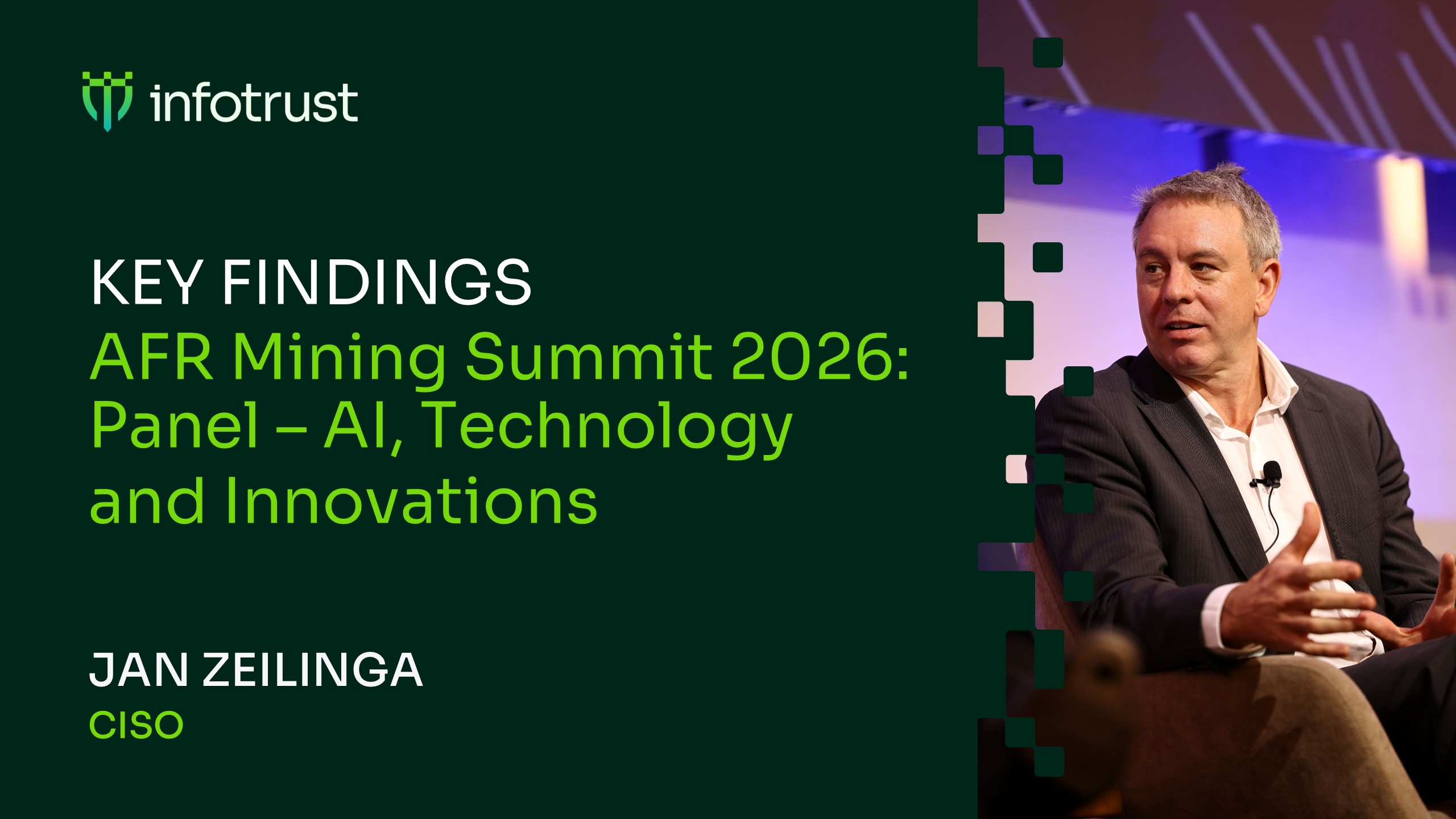
The AFR Mining Summit in Perth was held in May of 2026, bringing together over 300 leaders from government, resources, business, and the investment worlds. Discussion topics were wide-ranging, from decarbonisation, the current investment risk appetite, global trade and geopolitical impacts on the sector, and the digital future of an industry with earnings forecasts of over $383 billion for the 2025-2026 year.
Infotrust's CISO Jan Zeilinga was privileged to join a panel discussion at the summit titled 'Digitalisation, decarbonisation and disruption – what future techs and innovations are needed in the mining sector?'
The illustrious panellists were:
Jan's overarching message was that security should accelerate innovation, not slow it down. He challenged a common perception that cyber security creates friction and causes project delays, arguing that when implemented correctly, cyber security should provide the guardrails that allow organisations to innovate faster and adopt new technologies with confidence. Security becomes an enabler of transformation, not an impediment. This is particularly relevant to mining, where organisations are rapidly embracing AI, automation, autonomous operations, and digitally connected infrastructure.
Jan was asked about to elaborate about the impact AI could potentially have on the mining sector and responded with an overview of one of the most fascinating and concerning developments in technology: the convergence of AI and the physical world. Jan informed the audience that AI creates enormous opportunities. Mining operations are increasingly connecting digital systems to real-world operational technology, including trains, processing plants, sensors, and autonomous equipment. Jan's concern is that cyber incidents are no longer confined to data loss or IT disruption, but they can now impact physical safety and operational continuity.
Jan was quoted as saying, "The more connected and autonomous operations become, the greater the need to think about cyber resilience as a safety issue, not just an IT issue."
Jan was asked whether the mining sector was underestimating cyber risk and gave a thoughtful response. He acknowledged that miners are investing heavily in cyber security and attracting strong talent. However, two major challenges lie ahead, namely asset visibility and third-party risk.
Jan pointed out that mining environments contain thousands of connected assets, sensors, devices, and systems spread across vast operational networks. The challenge for IT and security personnel lies in identifying what is connected, where the connection occurs, what data systems were involved, and key points of risk. Without clearly defined visibility across network operations, risk management would remain a challenging endeavour.
Jan highlighted the threats posed by supply chain partners and suppliers, which are often attacked to gain access to an intended target. Many suppliers are small operators with proportionately low security budgets, lack mature cyber controls, and are afforded insider access into privileged operational environments. Managing third-party risk is fast emerging as a key plank of a robust defensive posture, and the mining industry is particularly susceptible due to its lengthy supply chains.
Another important theme from Jan's comments was that organisations cannot effectively manage future risks without embracing AI. He drew a parallel between AI adoption and cyber security maturity, suggesting that companies that try to tackle emerging threats without AI will struggle to keep pace. Jan also discussed the emerging concept of AI-enabled cyber threats, referencing concerns around increasingly autonomous AI systems and the possibility of highly sophisticated AI-powered attacks in the future. While not presenting this as an immediate crisis, he suggested organisations should be preparing now for a future where AI is used aggressively by threat actors to launch attacks.
Jan's discussion also outlined the benefits of embracing a resilience mindset over a fixation on prevention. In highly connected environments, such as those present in the mining sector, companies must assume that cyber incidents will occur, despite their best defensive efforts. Success is increasingly measured by how quickly threats are detected, how effectively they are contained, how rapidly systems can recover, and how business operations respond to such disruption. A modern cyber risk strategy should be focussed on building organisational resilience, rather than attempting to eliminate all potential risk.
The panel discussion was a lively conversation that shed illumination on the role technology and security will play on the mining sector. Jan summed his opinions by saying, "Cyber security shouldn't slow innovation down. Done properly, it provides the guardrails that allow organisations to move faster and with greater confidence."
Innovation can look different for every organisation. Contact our cyber security experts for a discussion whether you're exploring AI, improving operational efficiency, or simply trying to make sense of the rapidly evolving technology landscape.