

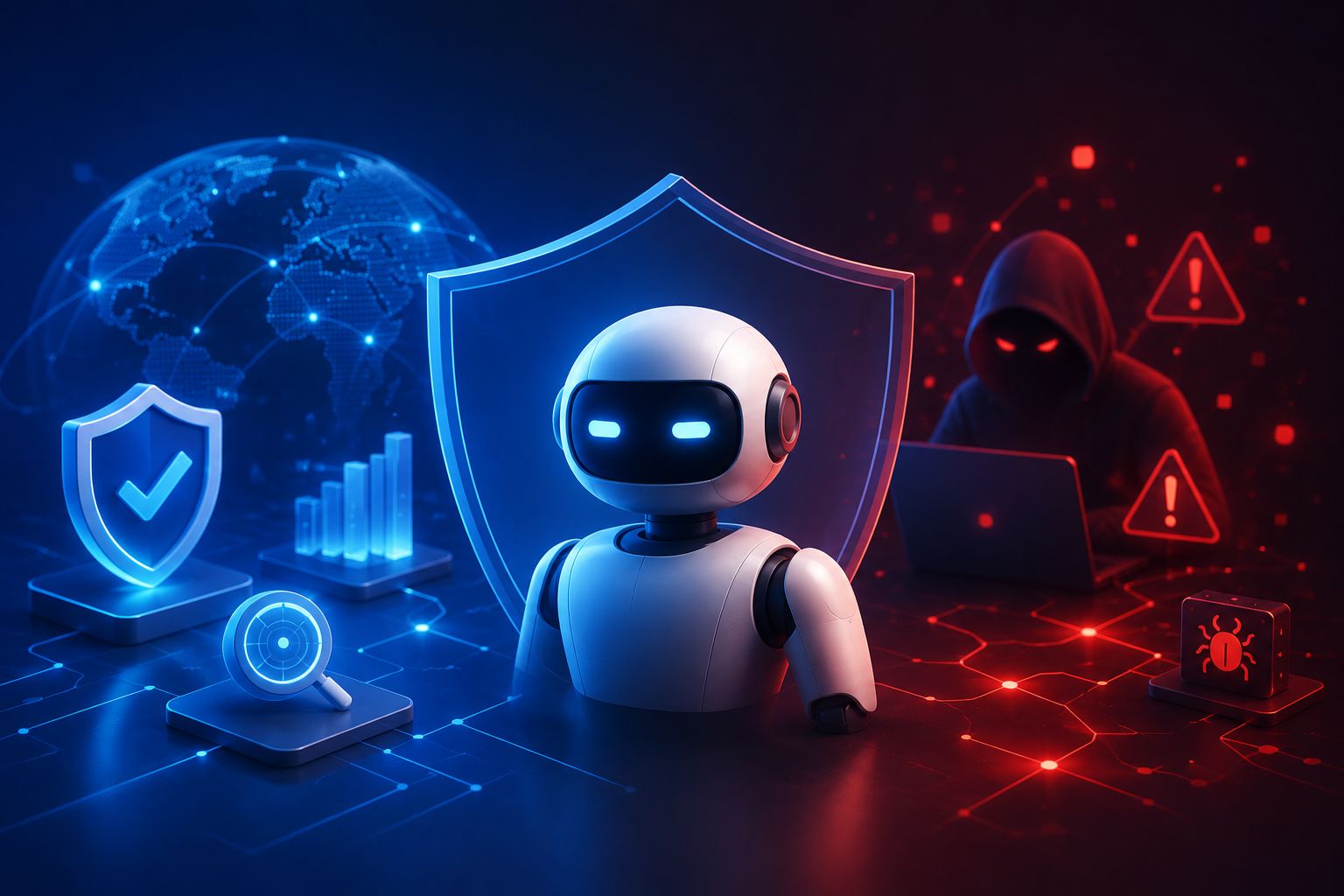
An autonomous AI agent is a software system that can perceive its environment, decide what to do and take action towards a goal with little or no human input. In cyber security, that ability is changing both sides of the fight: it’s helping defenders detect and respond to threats faster, and it’s giving attackers new ways to move at machine speed. Understanding what these agents are - and where a human still needs to stay in control - is becoming essential for any Australian business thinking about its security posture.
An autonomous AI agent is an AI system built to pursue a goal on its own. Rather than waiting for a specific instruction and returning a single answer, it works through a continuous loop: it perceives information about its environment, reasons about what that information means, decides on an action, and then acts - repeating the cycle as conditions change.
That makes it different from the AI tools most people have used. A chatbot responds when you prompt it and stops when it has answered. Simple automation follows a fixed set of rules and can’t adapt when something unexpected happens. An autonomous agent sits beyond both: give it an objective, and it can plan the steps, adjust as it goes and keep working towards the outcome without being told what to do at each stage. This is often described as "agentic" AI, because the software behaves less like a tool and more like an actor with a task to complete.
Most autonomous agents are built from four working parts.
The important shift is from assisting to acting. An AI assistant might tell a human analyst what looks suspicious; an autonomous agent can investigate and respond to it directly, within the boundaries it has been given. That capability is powerful, which is exactly why how it’s deployed matters so much.
On the defensive side, autonomous agents are most useful where speed and volume overwhelm human teams. Security operations centres deal with enormous numbers of alerts every day, and the majority turn out to be noise. Autonomous agents can triage that flood - investigating alerts, gathering context and dismissing false positives - so human analysts spend their time on the threats that genuinely need judgement.
They also enable faster autonomous incident response. When an agent detects a likely compromise, it can take immediate containment steps (such as isolating an affected device or disabling a suspicious account) in the seconds that matter most, then hand the situation to a human analyst with the groundwork already done.
Used this way, agents augment a security team rather than replace it. That’s the model behind a modern managed detection and response capability and the wider managed SOC: automated speed where it helps, experienced people where judgement is required.
The same technology is available to attackers, and they’re already using it. Agentic cyber attacks use autonomous agents to scan for weaknesses, adapt their approach when a defence blocks them, and carry out attacks at a scale and pace no human operator could match. That means faster, more persistent and more adaptive threats hitting Australian businesses.
No tool - AI or otherwise - can completely prevent this. What it does mean is that defenders can’t rely on manual, human-speed processes alone to keep up with machine-speed attacks. Matching automation with automation, under proper oversight, is becoming part of a credible defence.
Autonomous AI agents are a genuine advance for defenders, but they’re not a "set and forget" solution. They work best inside a program that keeps a human in the loop for the decisions that carry real consequences, and that continually checks the agent is behaving as intended. The businesses that benefit most will be the ones that adopt the capability deliberately - pairing the speed of automation with experienced people who know when to step in.
If you want to better understand how autonomous detection and response could strengthen your security posture, talk to the Infotrust team.